



Séminaire en études cinématographiques "Anatomie de la recherche" (6)
Publié le 16 janvier 2026
–
Mis à jour le 2 mars 2026
le 5 mars 2026
Campus Berges du Rhône
De 14h à 16h
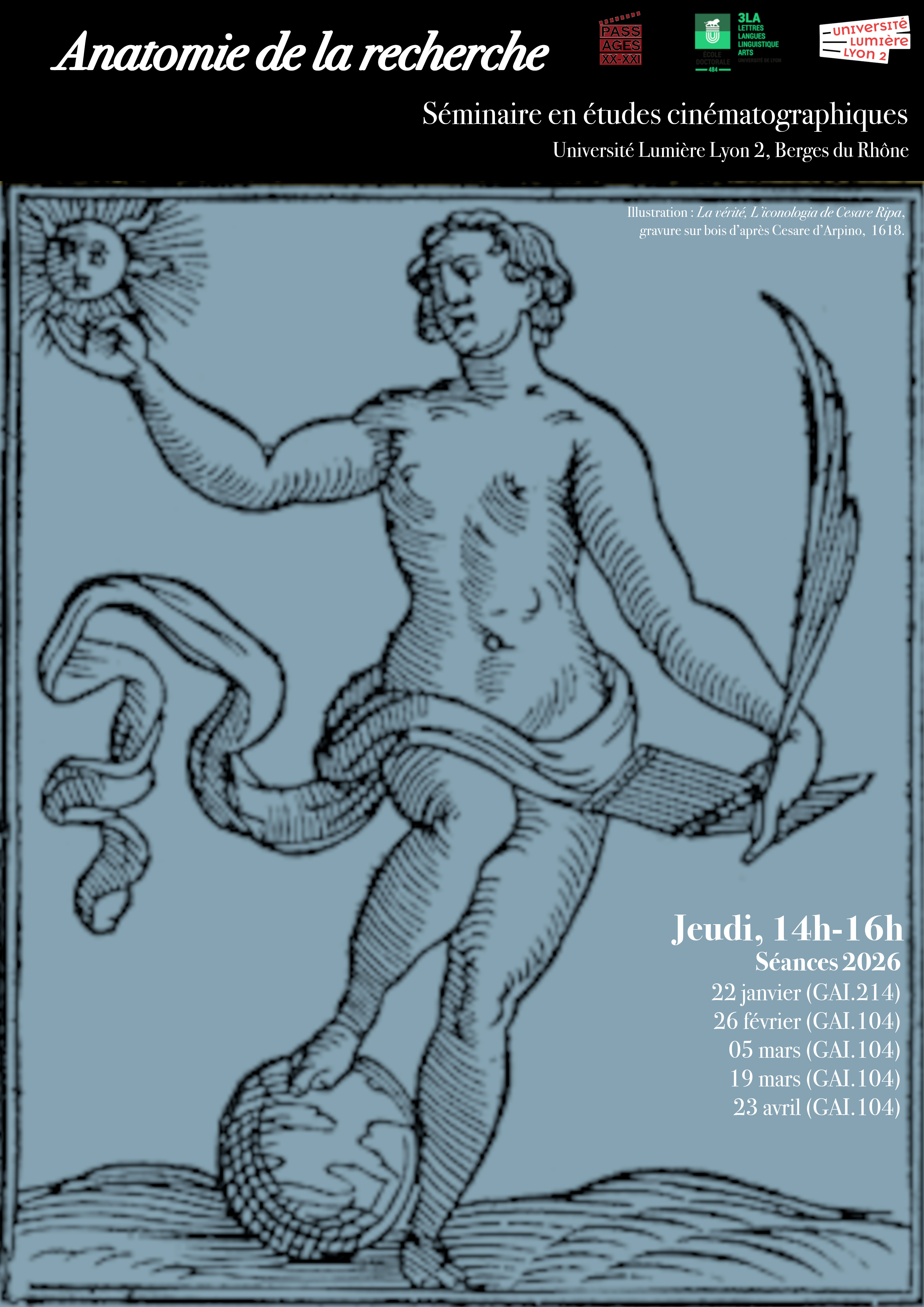
Le laboratoire Passages Arts & Littératures (XX-XXI) accueille pour l'année 2025-2026 le séminaire en études cinématographiques Anatomie de la recherche.
Ce séminaire en études cinématographiques est consacré à l'analyse, la théorie et l'histoire des images et du cinéma. Nous nous intéresserons tout particulièrement aux objets émergents ainsi qu’aux questions de méthodologie de la recherche liées à l’apparition de nouvelles orientations disciplinaires. Il accueillera les travaux des doctorant·es, docteur·es et enseignant·es-chercheurs·euses qui font l’actualité de la recherche.
Ce séminaire mensuel se tiendra sur le campus Berges du Rhône un jeudi par mois, de 14h à 16h.
Programme de la séance
Sneha Singh et Pappal Suneja, Bauhaus-Universität Weimar
« Coherence and Circulation: Cinema, Print, and the Ecology of Media »
Cinema presents modernity not merely as an idea or an ideology, but as a condition experienced through similarity and difference in relation to the spectator’s world. Building on Stanley Cavell’s (1971) account of cinema as presenting a world that is complete, yet unavailable to us, this study argues that cinematic worlds are coherent, inhabitable in imagination, and distinct from the lived reality.
It is this constitutive difference that allows modernity to appear as repeatable rather than purely historical. Cinema achieves this not only through narrative or the agency of protagonists, but equally, at an ontological level, through the arrangement of objects, domestic spaces, thresholds, movement, and conduct. Even when cinema presents dystopian or conflicted worlds, it renders modernity coherent, available, and livable as a condition.
Print media, by contrast, organizes modernity through fragmentation and multiplicity rather than world coherence. Here, “print” refers primarily to periodical culture—magazines, columns, captions, layouts, and thematic dossiers through which modernity circulates as a set of evaluative cues. As Mikhail Bakhtin (1981) argues, meaning emerges through the “social diversity of speech types” and the coexistence of differing voices without resolution into unity. Read through this lens, print media is then inherently polyphonic. It assembles images, texts, and judgments without synthesizing them into a single, unified world. Print thus produces modernity as a circulating, dialogic object; the one available for reflection, negotiation, and debate. Importantly, it treats cinema much like the “real” world itself: as a source of fragments rather than a totality. Images, spatial designs, objects, music, fashion, hairstyles, and ceremonies are extracted from films and recirculated within the dissonant swirl of social, cultural, and temporal contingencies that structure everyday life.
This research begins at this intersection. Juxtaposing cinema and print media reveals how modernity is simultaneously stabilized as a livable world and destabilized as a historically contested condition, circulating between coherence and dissonance across media forms. Methodologically, the study pairs close readings of selected films with the issue-based analysis of Design (1957–1988), tracking how recurrent motifs: interiors, objects, fashion, gestures move between screen, page, and everyday practice.
Further, the study primarily focuses on popular South Asian cinema and print media from the mid-twentieth century to the post-liberalization era, a period in which both forms exerted a strong cultural footprint. Cinema functioned as a mass, widely shared experience, while print media operated as a proximate yet historically specific site of circulation, instruction, and debate.
Through repetition, cinema endows domestic interiors, thresholds, object arrangements, spatial routines, and lived geographies with meaning, organizing conduct and reinforcing or contesting moral norms. Print media intervenes by fragmenting and recirculating elements of these films, particularly the design of objects, interiors, fashion, music, and gestures within the polyphonic field of periodical culture. Magazines such as Design (1957–1988) extend this process through layouts, typographic hierarchies, captions, thematic dossiers, and recurring visual conventions, instructing readers in how to recognize, evaluate, and internalize “good design.” As a periodical, Design is especially consequential because it transforms cinematic fragments into normative vocabularies of taste and expertise, teaching readers how to see, name, and judge the modern.
Therefore, rather than approaching cinema, print, and other media as separate domains, this study argues for an ecological perspective in which different forms participate in a shared economy of circulation. Cinema stages coherent worlds through repetition and immersion; print breaks these worlds into fragments and inserts them into dialogic, historically specific contexts; audio, photography, fashion, and ritual further extend this circulation by translating cinematic elements into everyday practices. Cultural meaning is thus produced across media rather than within any single form. What emerges is not a hierarchy of media, but an ecology in which coherence, dissonance, repetition, and circulation operate together.
Building on this framework, the study draws on Hayles’s (2012) account of technogenesis to examine how cognitive and affective engagements with cinematic worlds are extended and transformed across print, audio, fashion, and ritual practices. In parallel, Chun and Watkins Fisher (2016) emphasize how polyphonic circulation and networked attention produce meanings that are negotiated rather than delivered intact. Together, these perspectives reframe South Asian modernity not as a linear historical stage, but as a mediated achievement, stabilized through cinematic worldhood and contested through periodical polyphony.
By situating cinema and print within a distributed media ecology, this study opens avenues for examining how cultural forms emerge through interaction, translation, and circulation across historically and socially situated audiences. It invites interdisciplinary attention to materiality, affect, and practice, allowing images, sounds, objects, and behaviors to be traced across media ecologies as they shape situated cultural experience.
References
Bakhtin, Mikhail. The Dialogic Imagination: Four Essays. University of Texas Press, 1981.
Cavell, Stanley. The World Viewed: Reflections on the Ontology of Film. Harvard
University Press, 1971.
Chun, Wendy Hui Kyong, and Watkins Fisher, Anna (eds). New Media, Old Media: A
History and Theory Reader. 2nd ed. Routledge, 2016.
Design (India). Periodical, 1957–1988.
Habermas, Jürgen. The Structural Transformation of the Public Sphere: An Inquiry into a Category of Bourgeois Society. MIT Press, 1989.
Hayles, N. Katherine. How We Think: Digital Media and Contemporary Technogenesis.
University of Chicago Press, 2012.
Ce séminaire en études cinématographiques est consacré à l'analyse, la théorie et l'histoire des images et du cinéma. Nous nous intéresserons tout particulièrement aux objets émergents ainsi qu’aux questions de méthodologie de la recherche liées à l’apparition de nouvelles orientations disciplinaires. Il accueillera les travaux des doctorant·es, docteur·es et enseignant·es-chercheurs·euses qui font l’actualité de la recherche.
Ce séminaire mensuel se tiendra sur le campus Berges du Rhône un jeudi par mois, de 14h à 16h.
Programme de la séance
Sneha Singh et Pappal Suneja, Bauhaus-Universität Weimar
« Coherence and Circulation: Cinema, Print, and the Ecology of Media »
Cinema presents modernity not merely as an idea or an ideology, but as a condition experienced through similarity and difference in relation to the spectator’s world. Building on Stanley Cavell’s (1971) account of cinema as presenting a world that is complete, yet unavailable to us, this study argues that cinematic worlds are coherent, inhabitable in imagination, and distinct from the lived reality.
It is this constitutive difference that allows modernity to appear as repeatable rather than purely historical. Cinema achieves this not only through narrative or the agency of protagonists, but equally, at an ontological level, through the arrangement of objects, domestic spaces, thresholds, movement, and conduct. Even when cinema presents dystopian or conflicted worlds, it renders modernity coherent, available, and livable as a condition.
Print media, by contrast, organizes modernity through fragmentation and multiplicity rather than world coherence. Here, “print” refers primarily to periodical culture—magazines, columns, captions, layouts, and thematic dossiers through which modernity circulates as a set of evaluative cues. As Mikhail Bakhtin (1981) argues, meaning emerges through the “social diversity of speech types” and the coexistence of differing voices without resolution into unity. Read through this lens, print media is then inherently polyphonic. It assembles images, texts, and judgments without synthesizing them into a single, unified world. Print thus produces modernity as a circulating, dialogic object; the one available for reflection, negotiation, and debate. Importantly, it treats cinema much like the “real” world itself: as a source of fragments rather than a totality. Images, spatial designs, objects, music, fashion, hairstyles, and ceremonies are extracted from films and recirculated within the dissonant swirl of social, cultural, and temporal contingencies that structure everyday life.
This research begins at this intersection. Juxtaposing cinema and print media reveals how modernity is simultaneously stabilized as a livable world and destabilized as a historically contested condition, circulating between coherence and dissonance across media forms. Methodologically, the study pairs close readings of selected films with the issue-based analysis of Design (1957–1988), tracking how recurrent motifs: interiors, objects, fashion, gestures move between screen, page, and everyday practice.
Further, the study primarily focuses on popular South Asian cinema and print media from the mid-twentieth century to the post-liberalization era, a period in which both forms exerted a strong cultural footprint. Cinema functioned as a mass, widely shared experience, while print media operated as a proximate yet historically specific site of circulation, instruction, and debate.
Through repetition, cinema endows domestic interiors, thresholds, object arrangements, spatial routines, and lived geographies with meaning, organizing conduct and reinforcing or contesting moral norms. Print media intervenes by fragmenting and recirculating elements of these films, particularly the design of objects, interiors, fashion, music, and gestures within the polyphonic field of periodical culture. Magazines such as Design (1957–1988) extend this process through layouts, typographic hierarchies, captions, thematic dossiers, and recurring visual conventions, instructing readers in how to recognize, evaluate, and internalize “good design.” As a periodical, Design is especially consequential because it transforms cinematic fragments into normative vocabularies of taste and expertise, teaching readers how to see, name, and judge the modern.
Therefore, rather than approaching cinema, print, and other media as separate domains, this study argues for an ecological perspective in which different forms participate in a shared economy of circulation. Cinema stages coherent worlds through repetition and immersion; print breaks these worlds into fragments and inserts them into dialogic, historically specific contexts; audio, photography, fashion, and ritual further extend this circulation by translating cinematic elements into everyday practices. Cultural meaning is thus produced across media rather than within any single form. What emerges is not a hierarchy of media, but an ecology in which coherence, dissonance, repetition, and circulation operate together.
Building on this framework, the study draws on Hayles’s (2012) account of technogenesis to examine how cognitive and affective engagements with cinematic worlds are extended and transformed across print, audio, fashion, and ritual practices. In parallel, Chun and Watkins Fisher (2016) emphasize how polyphonic circulation and networked attention produce meanings that are negotiated rather than delivered intact. Together, these perspectives reframe South Asian modernity not as a linear historical stage, but as a mediated achievement, stabilized through cinematic worldhood and contested through periodical polyphony.
By situating cinema and print within a distributed media ecology, this study opens avenues for examining how cultural forms emerge through interaction, translation, and circulation across historically and socially situated audiences. It invites interdisciplinary attention to materiality, affect, and practice, allowing images, sounds, objects, and behaviors to be traced across media ecologies as they shape situated cultural experience.
References
Bakhtin, Mikhail. The Dialogic Imagination: Four Essays. University of Texas Press, 1981.
Cavell, Stanley. The World Viewed: Reflections on the Ontology of Film. Harvard
University Press, 1971.
Chun, Wendy Hui Kyong, and Watkins Fisher, Anna (eds). New Media, Old Media: A
History and Theory Reader. 2nd ed. Routledge, 2016.
Design (India). Periodical, 1957–1988.
Habermas, Jürgen. The Structural Transformation of the Public Sphere: An Inquiry into a Category of Bourgeois Society. MIT Press, 1989.
Hayles, N. Katherine. How We Think: Digital Media and Contemporary Technogenesis.
University of Chicago Press, 2012.
| Sneha Singh is a PhD Scholar candidate at the Chair of Media Philosophy, Bauhaus Universität Weimar, where she is supervised by Prof. Dr. Lorenz Engell. Her dissertation examines cinema’s world-making of domesticity in post-independence India. With a double Master’s background in Media Art & Design (Weimar) and Architectural Design Research (Stiftung Bauhaus Dessau / Hochschule Anhalt), her work bridges architecture, spatial theory, and media philosophy. Her Master’s thesis in Dessau explored cinematic representations of domesticity and gendered spatiality, laying the foundation for her current research. Sneha has published in Home Cultures (Taylor & Francis), Comunicazioni Sociali, and the Taylor & Francis conference volume Future Is Urban. She has presented her work at Chapman University and at India–Germany research colloquia. She is the recipient of the AJC+ Design Researcher Award 2025 and currently co-leads theForschungswerkstatt project From Process to Aesthetic: Recontextualizing Modernism in South Asia. |
| Pappal Suneja is a PhD Scholar at the Faculty of Architecture and Urbanism, BauhausUniversität Weimar. His research engages South Asian modernism, design historiography, media cultures, and transnatiFabriexchange between India and Germany. His recent projects include Gropius Protégés: Stimulating Architectural Modernism in India (2024) and Bauhaus & Beyond (2022–23), supported by Forschungswerkstatt at Bauhaus-Universität Weimar, and he is currently Project Associate for From Process to Aesthetic: Recontextualizing Modernism in South Asia. Pappal has held visiting positions at MIT, the German Historical Institute London, and the University of Brighton, and has presented invited talks at Harvard GSD and other international institutions. He teaches design thinking, architectural history, and research communication, and is the founder of the Architectural Journalism & Criticism Organisation (AJC+). His publications include Bauhaus & Beyond: A Global Postcolonial Perspective (2025) and Charles Fabri – An Art Critic: Building Bridges Between India & Europe (2024). |
Informations pratiques
Lieu(x)
Campus Berges du Rhône
Salle GAI 104 (bâtiment Gaïa)
86, rue Pasteur
69007 Lyon
86, rue Pasteur
69007 Lyon