



Séminaire international « Cinema Left Undone: A Secret History of Central European and Soviet Films (1920-1990) » (1)
International seminar (online)
Year 2 — 2026-2027
Lost and Recovered Film Projects: Fragments, Afterlives, Retakes
Link: https://teams.microsoft.com/meet/387398014503443?p=dMaw1g0e0FzhIp95lL
Meeting ID: 387 398 014 503 443
Passcode: MZ7u5dV2
— Thursday 15 October 2026, 4:30-6:30pm
- Pavle Levi (Stanford University):
Dušan Makavejev’s Murderers on the Yugoslavia Express (Speculative Archival Reconstruction of a Latent Film)
Discussant: Naïma Berkane (Sorbonne Université)
- Research program
-
Stakes
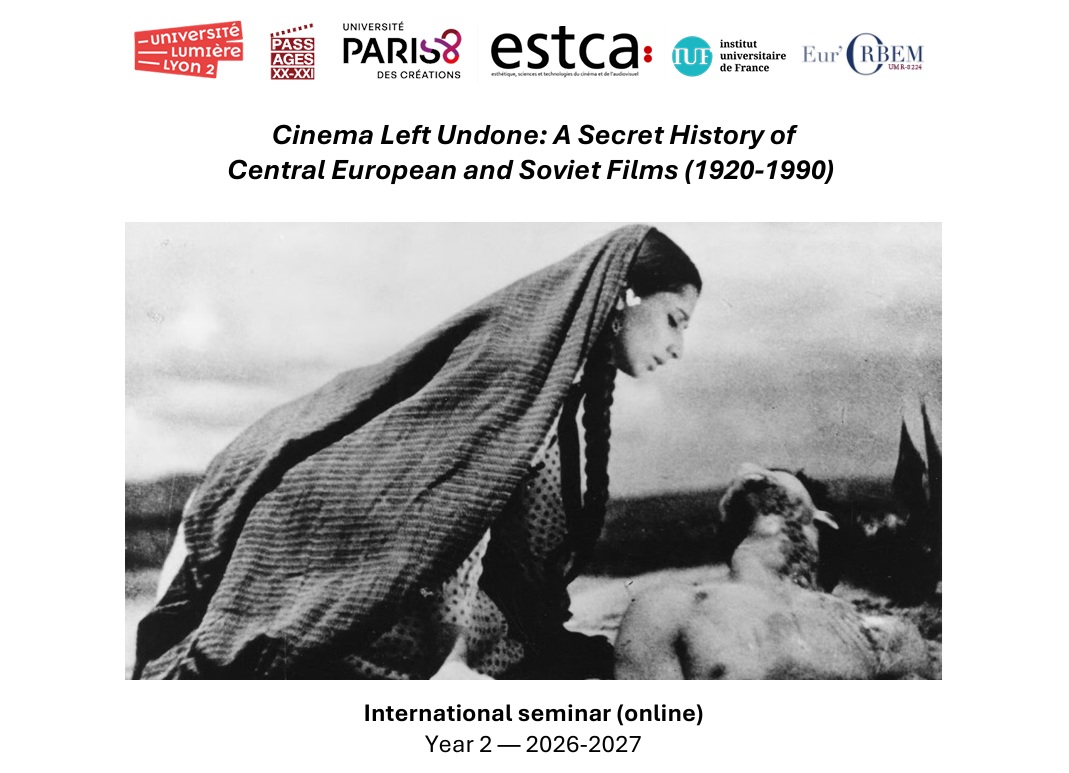
The renowned film ¡Que viva México! (Да здравствует Мексика!), directed by Sergei Eisenstein in 1932, was never completed due to political censorship. Grigori Alexandrov released an edited version of the film in 1979, more than thirty years after Eisenstein's death. What might this film, envisioned by one of the most internationally acclaimed filmmakers of his generation, have looked like in its intended form? We may never know with certainty, but archival documents and surviving images allow us to extrapolate and speculate. This unfinished film is emblematic of a broader phenomenon: the existence of film projects that never came to completion.
During the communist/Soviet era, many film projects launched in the Soviet contexts and in Central and Eastern Europe remained unfinished. The reasons are varied: strict ideological constraints, (un-official) political censorship, state repression, internalized self-censorship, accidental death of the director, etc. Great directors such as Oleksander Dovzhenko, Andrey Tarkovsky, Kira Muratova, Sergei Paradjanov, Miloš Forman, Jerzy Skolimowski, Krzysztof Kieślowski and Larisa Shepitko come immediately to mind, alongside countless lesser-known creators whose scripts were written but never filmed.
Just as many international researchers have reflected on the possibility of such a ‘history of cinema in negative’ (Jeannelle, 2014), this seems particularly important in the specific field that this seminar intends to study. These forbidden and impossible projects have an impact and permeate the histories of cinema and cinematographies, and must be studied and mapped. Furthermore, while some unrealised screenplays by famous directors have been published and discussed, researchers' interest remains largely ‘author-centred’. It seems important to also consider the place of lesser-known screenwriters and directors faced with such difficulties and frustrations to reveal how these episodes in filmmaking influence and alter working relationships and reveal how professionals perceive themselves and their work in the socialist context.
The transdisciplinary research program investigates both the conditions under which film projects were developed and the diverse factors that prevented their completion (or led to their completion under unexpected conditions). Approaching an impossible history of cinema from a decolonial perspective, the project seeks to map the secret continents of Central European and Soviet cinematographies from 1920 to 1990. - Scientific coordination
-
Mathieu Lericq (Associate Professor, Université Lyon 2)
Eugénie Zvonkine (Professor, Université Paris 8) - Institutions
-
Université Lumière Lyon 2 (PASSAGES XX-XXI)
Université Paris 8 Vincennes Saint-Denis (ESTCA)
Institut Universitaire de France
UMR Eur’ORBEM (Sorbonne Université / CNRS)
Informations pratiques
Lieu(x)
En distanciel (visio / live)